
• Skip to main content
Logo of Datachieve Digital featuring a stylized
800.706.1191Contact Us

Menu

  • Home
  • About Us
  • Our Services
  • Our Work
  • News
  • Testimonials
  • We’re Hiring
  • Contact Us

The DatAchieve Team

A person holds a tablet displaying a login screen for the "Internal Revenue Service" website, showing fields for user ID, password, a "Remember me" checkbox, and options to log in or recover a forgotten password.

The Gist

Member expectations are rising faster than budgets. In 2025, your website isn’t just a communications tool—it’s the engine that drives renewals, registrations, and retention.

  1. Members expect on-demand everything.
    • They want self-service portals for payments, profiles, and resources.
    • Mobile usability matters more than ever—over 70% of members now access association sites from a phone.
    • If your website and portal experience isn’t frictionless, your renewal rate will show it.
  2. Data privacy and compliance are non-negotiable
    • State-level privacy laws (think California, Colorado, Connecticut) now affect national organizations.
    • Collecting member data through non-secure forms or third-party widgets can expose you to liability.
    • Audit how data moves between your CRM, email platform, and website.
  3. Integration beats innovation
    • You don’t need new software—you need your existing systems talking to each other.
    • Link your AMS or CRM with your website and event tools for a single source of truth.
    • Dashboards that show renewals, registrations, and engagement in one place will save your staff hours each week.
  4. Accessibility equals professionalism
    • Accessibility lawsuits are increasing, and WCAG 2.2 standards are now widely enforced.
    • An accessible website isn’t just compliance—it signals respect for every member.
  5. Ongoing management is the new membership benefit
    • Sites that aren’t maintained regularly lose trust—and search rank.
    • Assign internal or external ownership for updates, backups, and analytics.
    • The most effective organizations treat digital management as part of their operations, not an afterthought.

The takeaway

Members notice when digital systems work—and when they don’t. A well-managed, compliant, and connected membership website builds confidence in your organization and keeps renewals coming in.

Recent Posts

  • Staying HIPAA-Compliant During a Heavy Flu & COVID Season
  • Skipping OLO? It’s Affecting Your Business
  • Prepared for the Holiday Rush? How About Your Website?
  • Hidden HIPAA Landmines on Digital Platforms
  • We’re Hiring-Full Stack Web Developer

    Filed Under: Destinations & Tourism, Non-Profit, Web Design & Development, Web Trends

    You can’t always see what’s wrong with your website by clicking around. We dig deeper—mapping content, tracking real user behavior, and uncovering hidden issues that affect performance, findability, security, and compliance. Before we ever propose a solution, we deliver insights that reshape the conversation.


    Curious how we help clients act on what an audit uncovers? Here’s how we use dashboards to track content, budget, and performance across platforms.

    And if you’ve ever considered using AI tools for technical tasks like DNS updates, read what happened when one client tried it—and what it cost him.


    What’s Really Going On With Your Website?

    We recently reviewed a client’s website and tracked the journey of a visitor who was searching for a particular program offered by the organization. The visitor typed the program name into the site’s search bar but left out a hyphen. The search returned nothing, and they left.

    That program was there. The user just couldn’t find it.

    And that’s the kind of thing you won’t catch just by clicking through your site or reviewing analytics dashboards. But it’s exactly the kind of thing we look for—and fix.

    Before we take on website management or propose a redesign, we audit. Not as a standalone service, but as a crucial step in making sure we’re solving the right problems—and creating measurable improvements.

    What We Uncover

    We approach audits as both a diagnostic and a baseline. Here’s what that looks like in practice:

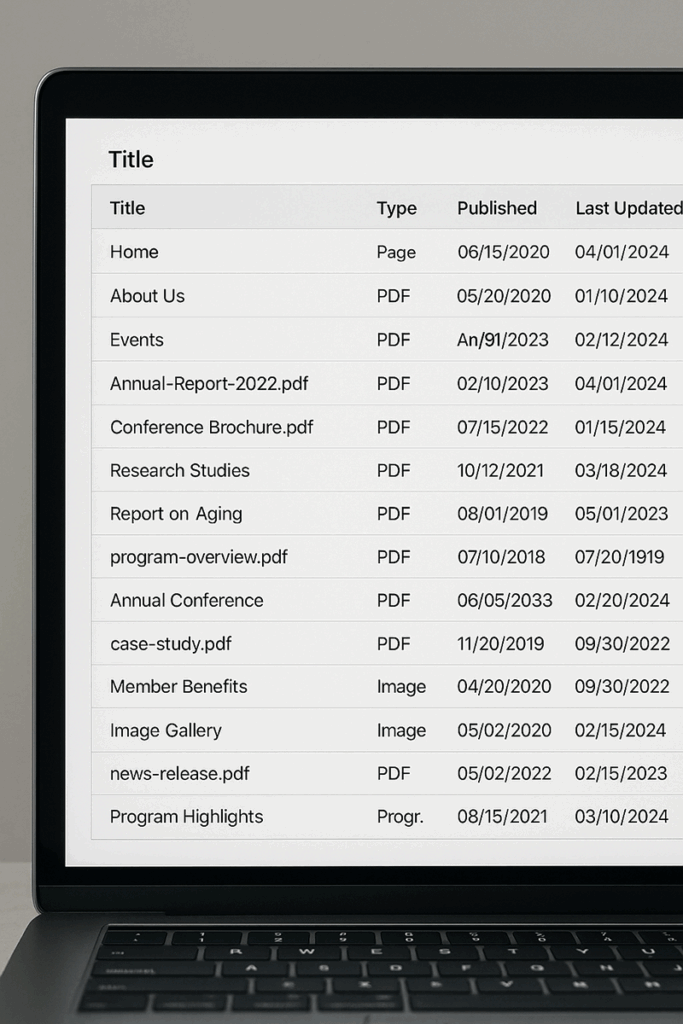
    Computer screen displaying a table of website content, including titles, file types (PDF, page, image), and columns labeled 'Published' and 'Last Updated,' illustrating a detailed content audit.
    • Comprehensive Content Audit
      We catalog every page, image, PDF, and file on your site. Each asset is logged with its original publish date and last update. That means we’re not just looking at what’s there—we’re looking at what’s stale, what’s duplicated, what’s invisible to users and search engines, and what needs to go.
    • User Behavior Mapping
      We use session tracking to observe how real users interact with your website. Where they click. Where they hesitate. Where they get lost or give up. Watching an actual visitor’s journey—scrolling, searching, struggling—can change how your team thinks about digital strategy.
    • Comprehensive Content Audit
      We catalog every page, image, PDF, and file on your site. Each asset is logged with its original publish date and last update. That means we’re not just looking at what’s there—we’re looking at what’s stale, what’s duplicated, what’s invisible to users and search engines, and what needs to go.
    • Technical & Search Visibility Audit
      Are there broken links, orphaned pages, or bloated plugins dragging down performance? Are your pages being properly indexed by search engines? Is your internal search delivering relevant results? These are the issues that quietly shape how well your website supports your organization—and whether it’s showing up when people go looking.
    • Security & Privacy Review
      We evaluate the site for outdated software, unpatched vulnerabilities, and poor password practices. But we also take a serious look at data exposure and compliance with regulations like GDPR, HIPAA, CCPA, and ADA accessibility. If your organization handles sensitive information or serves the public, this part is non-negotiable.

    Why It Matters

    Most websites evolve organically. Teams make updates, vendors change, plugins get installed, priorities shift. Over time, the structure that once worked can become hard to manage, harder to understand, and impossible to evaluate without a fresh set of eyes.

    Our audits give you that clarity:

    • What’s working well
    • What’s putting you at risk
    • What’s confusing users
    • What’s holding you back
    • And most importantly—what to do next

    The result isn’t a long list of problems. It’s a roadmap, prioritized by urgency and impact, that your team can use—whether we handle the fixes or not.

    A Smarter Starting Point

    Our audits aren’t about finding flaws. They’re about uncovering opportunity—and making sure every decision from that point forward is grounded in facts, not assumptions.

    We’ve seen organizations rethink not just their websites, but their messaging, workflows, and outreach strategies after going through this process. And after launch, we use the original audit as a benchmark—so we’re not just delivering a fresh look, but measurable improvements in performance, accessibility, and user engagement.

    Curious What Your Site Might Reveal?

    You might be surprised at what’s hiding just beneath the surface. We’d be glad to take a look—and start a real conversation about what’s working, what’s not, and what’s next.

    Contact Us to Learn More >

    Recent News

    • Staying HIPAA-Compliant During a Heavy Flu & COVID Season
    • Skipping OLO? It’s Affecting Your Business
    • Prepared for the Holiday Rush? How About Your Website?
    • Hidden HIPAA Landmines on Digital Platforms
    • We’re Hiring-Full Stack Web Developer

    Filed Under: Business, SEO & Marketing, Web Design & Development, Web Trends

    Making the Numbers Make Sense with Key Metrics Dashboards

    Recently we’ve been helping clients identify redundancies, overlaps, and outdated platforms, and building dashboards that go beyond web traffic—they connect ad spend, site visits, and actual sales in one place. By utilizing custom business dashboards with tools like Looker Studio and Tableau, businesses can gain invaluable insights.

    The big idea:
    Use tools like Looker Studio and Tableau to pull business intelligence together, so clients can actually see what’s working.

    Why it matters:
    Clients are overwhelmed by disconnected tools
    Jumping between tabs kills clarity
    Most just want to make decisions without a data scavenger hunt

    What we’re doing:

    • Conducting audits of client’s existing platforms
    • Building custom dashboards that show trends over time (monthly, quarterly, YoY)
    • Connecting ad spend to sales outcomes—not just vanity metrics
    • Asking: What can we remove? as often as What should we add?
    • Helping teams focus on what’s actually happening in their systems

    The takeaway:
    This isn’t about more data.
    It’s about making the right data easier to see—so people can act on it and move on.

    If that kind of clarity sounds useful, we’re happy to talk through what’s possible.

    Recent Posts

    • Staying HIPAA-Compliant During a Heavy Flu & COVID Season
    • Skipping OLO? It’s Affecting Your Business
    • Prepared for the Holiday Rush? How About Your Website?
    • Hidden HIPAA Landmines on Digital Platforms
    • We’re Hiring-Full Stack Web Developer

    Filed Under: Business, SEO & Marketing, Uncategorized, Web Design & Development, Web Trends

    A DNS Misstep That Took Everything Offline

    We recently heard from someone in a panic. Their website was down, email wasn’t working, and orders had stopped. The problem? They had asked ChatGPT how to add a service to their site. Among other tips, it mentioned modifying their DNS records. So they did—without realizing what DNS does or how it touches nearly everything tied to their domain.

    To be fair, AI wasn’t wrong. It gave good advice—within the context of the chat. But without knowing the full setup, things can go sideways fast.

    We’re not anti-AI. Quite the opposite—we use it every day to help us write, plan, analyze, and solve problems faster. In fact, we encourage our clients to use tools like ChatGPT, especially when it helps them:

    • Generate ideas for blog posts or FAQs
    • Understand marketing terms or tech jargon
    • Brainstorm product descriptions or headlines
    • Explore ways to improve SEO or site performance
    • Draft responses to customer questions

    But when it comes to taking action, especially on things like DNS, web hosting, or platform updates, it’s worth pausing. AI doesn’t know what your particular environment looks like. It won’t know if your site is using Cloudflare, whether your mail is handled by Google Workspace or Outlook, or if there’s a legacy integration hiding in the background. We do. Here’s how we think about it:

    • Use AI for first drafts, brainstorming, and exploration.
    • Use us when you’re about to press a button you’re not sure about.
    • Or better yet—loop us in as part of the process. We’re happy to advise, review, or jump in when needed.

    AI is a great tool. So are we. Use both.

    Recent Posts

    • Staying HIPAA-Compliant During a Heavy Flu & COVID Season
    • Skipping OLO? It’s Affecting Your Business
    • Prepared for the Holiday Rush? How About Your Website?
    • Hidden HIPAA Landmines on Digital Platforms
    • We’re Hiring-Full Stack Web Developer

    Filed Under: Business, Uncategorized, Web Design & Development, Web Trends

    A close-up of the back of a blue denim jacket with the words "WE SEE WHAT WE WANT" stitched in black thread above a buttoned pocket.

    “There are three kinds of lies: lies, damned lies, and statistics.” The quote is often attributed to Mark Twain, though he borrowed it from British Prime Minister Benjamin Disraeli.

    The truth is, statistics can be bent to say almost anything. We see what we want. But some numbers are too consistent to ignore—especially when it comes to how people experience your website.

    Your website is your first impression. Content helps you get found, but design and speed decide whether visitors trust you—or bounce.

    At a Glance

    • 94% of first impressions are design-related.
    • 93% leave if a site doesn’t display properly on their device.
    • 53% abandon mobile sites that take more than 3 seconds to load.
    • 75% judge an organization’s credibility by its website design.

    Why You Should Care

    Bad design costs trust. Slow performance kills conversions. A well-designed, responsive site builds credibility and drives results.

    Next Steps

    • Audit site speed and mobile performance.
    • Update design to reflect trust and usability.
    • Simplify navigation to reduce bounce.
    • Refresh regularly — an outdated site looks untrustworthy.

    A Deeper Look

    Here’s what the latest research says about design, user behavior, and performance in 2025.

    Behind the Numbers

    Design and Trust

    • Design is credibility. Stanford University research found that 75% of users judge an organization’s credibility based on its website design (Stanford Guidelines for Web Credibility).
    • First impressions stick. A majority of feedback about websites — 94% — is design-related, not content-related (ResearchGate).

    Speed and User Patience

    • Two seconds or less. Nearly half of users expect a site to load in under 2 seconds. 53% abandon a mobile page that takes longer than 3 seconds (Google/SOASTA Research).
    • Bounce rates climb fast. As page load time increases from 1 to 3 seconds, the probability of a bounce increases by 32% (Google Think with Google).
    • Conversions suffer. A 1-second delay in mobile load time can cut conversions by as much as 20% (Akamai Research).

    The Scale of the Web

    • Over a billion websites. As of 2025, there are more than 1.09 billion websites, though less than 20% are active (Internet Live Stats).
    • WordPress leads. WordPress powers about 43% of all websites, making it the most widely used content management system (W3Techs).

    Bounce Rates by Industry

    • E-commerce: 20–45%
    • Blogs/content: 70–90%
    • SaaS: 35–55%
    • Service businesses: 10–50%
    • B2B sites: 30–55%
    • B2C sites: 35–60% (Source: CausalFunnel)

    Read More

    • Stanford Guidelines for Web Credibility
    • Google: Why Speed Matters
    • W3Techs: CMS Market Share
    • CausalFunnel: 2025 Bounce Rate Benchmarks

    Recent Posts

    • Staying HIPAA-Compliant During a Heavy Flu & COVID Season
    • Skipping OLO? It’s Affecting Your Business
    • Prepared for the Holiday Rush? How About Your Website?
    • Hidden HIPAA Landmines on Digital Platforms
    • We’re Hiring-Full Stack Web Developer

    Filed Under: Business, Digital Marketing, Web Design & Development

    By now you know the risks of hacking and identity theft. Yet most people still fall back on easy-to-remember logins. Maybe you think, “Nobody’s going to guess my cat’s name and my birthday.” You’re right—nobody will. But the automated scripts that hit every website with millions of password attempts a minute just might.

    If you want to avoid trouble, here are the best ways to create strong passwords in 2025—plus a look at the rise of passwordless passkeys.

    Password Security Best Practices

    • Use at least 16 characters (letters, numbers, and symbols).
    • Don’t rely on dictionary words—hackers test those first.
    • Skip obvious substitutions (like “f0r3ver” for “forever”).
    • Avoid predictable combos (birthdays, names, or “123456”).
    • Never reuse passwords across multiple accounts.
    • Turn on Multi-Factor Authentication (MFA/2FA) wherever available.
    • Consider passkeys—a new passwordless login option supported by Apple, Google, Microsoft, banks, and more.

    For more on how people interact with websites and security, see Website Statistics to Know in 2025.

    3 Ways to Create and Remember a Strong Password

    1. First Letter Method

    Take the first letter of each word in a sentence, lyric, or book title and mix in numbers and symbols.

    “The name of my first dog was Max! We lived at 115 Main Street.” becomes: “TnomfdwM!Wla115MS.”

    Random Word + Symbol Trick

    A man wearing a white "Good Humor" uniform and cap licks an ice cream cone while pushing a lawn mower on a grassy lawn. Trees are blurred in the background.

    Instead of remembering a long string of letters and numbers you could memorize four random words and toss in an ice cream cone emoticon for fun:

    Just imagine the Good Humor man mowing the lawn while eating an ice cream cone. A mnemonic device like this will ensure that it’s stuck in your head forever!

    “IceCreamLawnmowerMan~oO>”

    The visual connection helps cement it in your memory.

    3. Set It and Forget It with a Password Manager

    Today, nearly every browser and device offers a secure password manager. Tools like Google Password Manager or dedicated apps generate strong logins and keep them encrypted across your devices. You only need to remember one master login.

    Here are The Best Free Password Managers for 2025 from PC Magazine.

    Passkeys vs. Passwords: The Future of Login Security

    Passwords aren’t going away overnight, but passkeys are gaining ground. They use device-based cryptography—meaning your fingerprint, face scan, or device PIN is the “password.” They’re phishing-resistant and easier to use than traditional logins.

    Expect to see more websites and apps offering passkeys as a login option in 2025.

    Keep Your Website and Accounts Safe

    A strong password (or passkey) plus MFA is your best defense. And if you’re managing a website, you’ll want to make sure your user accounts, plugins, and hosting environment are just as secure.

    • Before you make changes, consider a website audit to uncover security gaps, performance issues, and outdated plugins.
    • If your site is due for an overhaul, read Before You Redesign: The Website Audit That Informs Smarter Decisions.
    • Or, if you’re simply overwhelmed by the number of digital platforms you’re managing, check out Simplifying How You See Your Business.

    And of course—contact us if you’d like help keeping your organization’s site and data safe.

    Recent Posts

    • Staying HIPAA-Compliant During a Heavy Flu & COVID Season
    • Skipping OLO? It’s Affecting Your Business
    • Prepared for the Holiday Rush? How About Your Website?
    • Hidden HIPAA Landmines on Digital Platforms
    • We’re Hiring-Full Stack Web Developer

    Filed Under: Business, Uncategorized

    A workspace with a laptop, a notebook, a smartphone displaying “Plan 2025” with a numbered list, a wireless mouse, a cup of coffee, two stones, and a dried grass stem on a white marble surface.

    Inbound marketing has been around for nearly two decades, but is it still effective in today’s world of AI-driven content and pay-to-play social media? Is inbound marketing still relevant in 2025? The short answer is yes—but the approach has evolved. Organizations that integrate content marketing, SEO, social media, and marketing automation into a clear strategy continue to generate qualified leads and build long-term trust. At DatAchieve, we use platforms like ActiveCampaign to connect content, email, and analytics so inbound efforts deliver measurable results.

    Why inbound still works

    • Buyer behavior has changed. Audiences research online before contacting you.
    • Content builds trust. Blog posts, videos, and guides attract the right audience.
    • SEO drives visibility. Search is still one of the most effective digital marketing channels.
    • Lower cost. Inbound often produces higher ROI than outbound ads when executed well.

    What’s different in 2025

    • Clutter is real. With AI-generated content everywhere, quality and authenticity stand out.
    • Integration is key. Inbound works best when tied to CRM, automation, and analytics dashboards.
    • Human to Human. Clear, useful communication beats hype.

    DIY vs. Agency

    • In-house? Works if your team has SEO, writing, and campaign management expertise.
    • Agency partner? Brings experience, creative resources, and tools your staff may not have.
    • Hybrid? Many organizations blend internal knowledge with agency support for the best outcome.

    Ultimately, the decision will depend on your specific needs and circumstances. We would be happy to provide you with any information you need  to conduct a cost-benefit analysis to compare the costs and benefits of both approaches. Want to see how inbound fits with your broader digital marketing strategy? Let’s talk.

    Recent Posts

    • Staying HIPAA-Compliant During a Heavy Flu & COVID Season
    • Skipping OLO? It’s Affecting Your Business
    • Prepared for the Holiday Rush? How About Your Website?
    • Hidden HIPAA Landmines on Digital Platforms
    • We’re Hiring-Full Stack Web Developer

    Filed Under: Business, Digital Marketing

    by Hannah Nance

    When contemplating traditional art, where does your mind wander? Perhaps to the Renaissance era, with luminaries like Leonardo DaVinci? Or maybe to the enchanting realm of Impressionism, inhabited by Monet and Vincent Van Gogh? You might be pondering how these venerable artistic styles influence digital art. After all, can digital art truly compare to the masterpieces of classical artists?

    Leonardo DaVinci was not merely a painter; he was also a scientist. His artwork often employed geometric shapes, precise ratios, and subdued tones to accentuate his vision. Monet favored lighter hues, while Van Gogh excelled in imbuing his works with tangible texture. Digital art, ever-evolving, offers the advantage of creating both realistic renderings and venturing into the realm of abstract fantasy. Let’s delve into how traditional art can be translated into the digital medium.

    The realm of marketing and digital media, traditional art and strategy are evident. Painters may carefully select color and shapes to evoke emotions, meanwhile marketers strategically write messages and visuals to resonate with their target audience. Color theory, composition, and storytelling play a big role in creating compelling marketing campaigns.

    Color Theory

    Color theory stands as a cornerstone in art creation, encompassing shading, the interplay of primary and secondary colors to convey depth, contrast, and visual allure. Artists use colors to convey mood and meaning, marketers apply color psychologically to evoke emotions and associations. Understanding the impact of colors on a person, allows for creatives to design logos, websites and advertisements that resonate with an audience.

    Geometric architectural wall with green square tiles forming a three-dimensional pattern. Rectangular vents are embedded within the tiles, creating a modern and abstract design. Shadows cast varying shapes across the surface.

    Structural Composition

    Recall how DaVinci incorporated ratios into his compositions. Extending to all art forms, including website design. Visual composition aims to captivate viewers, employing elements and principles such as shapes, colors, balance, repetition, and texture. These compositional guides both artists and marketers in organizing elements harmoniously to draw attention to key focal points in their design. Considering all these elements are essential for effective communication.

    Creativity

    Both artists and coders rely on creativity to execute their projects. When it comes to crafting a painting or or writing code, the ability to think outside the box and explore non-traditional solutions is an important key for innovation and originality.

    Key Takeaways

    Essentially, in a world constructed by technology and innovation, the integration of traditional art techniques in fields like marketing and coding, highlight foundational principles. As we continue to push the boundaries of possibility, the fusion of art and technology paves the way for limitless creativity and endless innovation!

    Filed Under: Design

    With the hustle and bustle of the holiday season, it’s understandable if your website takes a backseat. Between preparing for higher customer demand and planning celebrations at home, your attention is stretched thin. But don’t let your website fall by the wayside – a little extra effort now can pay dividends during your busiest time of year. Here are a few ways to make sure your website is ready for the holiday season:

    1. Mobile Responsive

    With holiday shopping increasingly happening on mobile devices, having a responsive website is crucial for capturing those impulse purchases. Social media and email campaigns often direct customers straight to your site via mobile, where shopping cart abandonment rates already tend to be high. If your website is not optimized for the smaller screens of smartphones and tablets, you could be losing out on a significant portion of revenue during your most profitable season.

    Ensuring your site seamlessly adapts to any screen size through responsive design techniques enables customers to easily browse and buy when inspiration strikes, whether they first access your site on desktop or mobile. You can take a look by right-clicking “inspect” on your website and changing the device to look at. 

    2. Image Optimization

    With today’s high-resolution displays and growing page sizes, unoptimized images can significantly slow down your website’s load times. Large, uncompressed photos might look fantastic on desktop, but on mobile connections they drain data allowances and cause slow loading that damages user experience. Reducing image file sizes through compression and scaling down resolution for the web not only speeds up load times, it also decreases bandwidth costs. Optimized images stop users from abandoning your site due to the excessive waits.

    A good habit to get into is using tinypng.com to upload your image too before adding it to your website. This will compress the file size but still keep the image at a good quality.

    3. Work with a Website Management and Hosting Agency (hey, sounds like us!)

    Consider outsourcing your website management and hosting to an agency. Their expertise and 24/7 monitoring ensures your site stays optimized and experiences minimal downtime year-round. Agencies can readily scale to accommodate traffic spikes, implement security and speed enhancements, and provide emergency maintenance even during off-hours. This round-the-clock support gives you peace of mind knowing your website is always in capable hands. 

    4. Create a Holiday Traffic Forecast

    Create holiday traffic forecasts by analyzing past site analytics for peaks during promotional and seasonal high points. Factor in any new marketing efforts or site changes that could boost traffic. Build in at least 20% overhead on pageview, visitor, and transaction projections. Examine traffic source patterns and geographic trends to inform capacity planning. Setting realistic forecasts based on previous holiday data allows you to adequately scale hosting, CDNs, server resources, and bandwidth. Revisiting accuracy post-holidays improves future predictions. Accurate forecasting ensures your website can smoothly handle the upcoming seasonal rush.

    5. Test and Secure Payment Systems

    Stress-test your checkout and payment gateways using load testing tools to uncover performance issues and security flaws when handling heavy transaction volume. Confirm your TLS certificates, encryption, and PCI compliance are up-to-date to protect customer data, especially during the high-risk holidays. Monitor transactions closely for anomalies and have a backup payment provider ready in case your main system fails. By auditing code, installing WAFs, and keeping checkout pages optimized, you can identify and resolve payment vulnerabilities. Rigorous testing and security of your website’s transactions during peak season reduces abandonment and instills customer trust when sales matter most

    Takeaways

    Optimizing your website for the holiday rush may seem daunting, but being proactive now pays off. Tackling these website enhancements early helps avoid scrambling right when traffic spikes. Consider outsourcing maintenance to a web management agency. Their expertise ensures your site stays secure, fast, and reliable amid the busiest season. Investing in your website’s holiday readiness provides peace of mind knowing it can handle the upcoming surge in traffic. Don’t wait until the last minute – take steps today to maximize your website’s performance when it matters most.

    Filed Under: Design

    September is here which means next week is Halloween, and the following is Thanksgiving and wait – you haven’t started your holiday shopping yet!? Just kidding, but that’s how it can feel with the next couple months coming up. When it comes to marketing your business during the holidays, it’s wise to start planning early. Rather than waiting until the last minute, let’s put together a list of marketing ideas you can implement for the upcoming holiday season.

    Before jumping into specific tactics, take some time to review your overall marketing strategy. Consider your business’s goals, core messaging, and current plans. While some of these might not work for your particular business, here are some ideas to help you get started. By first understanding your existing strategy, you’ll be better equipped to determine which holiday marketing tactics to pursue. Once you’ve evaluated your current approach, you can then decide which of these suggestions to integrate into your efforts over the next couple months. Advanced planning will set you up for marketing success this holiday.

    September:

    • Offer end of summer sales and clearances. Advertise that supplies are limited for major discounts on summer inventory as you transition to fall.
    • Promote back to school specials. Offer deals for students and parents stocking up for the new school year.
    • First day of Autumn is September 21st, so get creative with displays and promotions for fall foliage and pumpkin themes.
    • Send emails announcing new fall product arrivals. Share previews of fresh inventory perfect for fall activities and cooler weather.
    • Partner with other local businesses to host a community fall festival. Provide coupons, samples, or prizes to draw families and increase visibility.

    October:

    • Promote National Coffee Day on October 1st by offering free coffee or special deals on coffee purchase or by supporting your local coffee shop.
    • Sponsor a Trunk or Treat event providing candy or coupons to families. Get exposure for your business while giving back.
    • Decorate your window displays with fall wreaths, leaves, hay bales, or other fall foliage. Draw attention from passersby.
    • Create Halloween-inspired products like donuts with pumpkin icing or candy corn cookies to attract customers.
    • Use fall slogan – “Falling in Love with (product/business)”
    • Host an Oktoberfest event with seasonal food and drinks.

    November:

    • Create a Holiday Gift Guide – Send an email or post a guide showcasing gifts and deals for Black Friday, Cyber Monday, and the holidays.
    • Sponsor a Turkey Trot – Get exposure by having a booth or sponsoring a local 5K race before Thanksgiving. Give out coupons.
    • Promote Black Friday and Cyber Monday Deals – Offer deep discounts and limited quantity deals to draw shoppers on the biggest shopping days. Promote online and in-store.
    • Partner with charities for Giving Tuesday promotions. Offer to donate a percentage of sales or provide volunteer.
    • Send early access holiday deals to loyalty program members to show appreciation and get word-of-mouth buzz.

    December:

    • Send holiday greeting emails and cards to customers thanking them for their support this year. Include a coupon or promo code.
    • Offer holiday deals and discounts for Christmas, Hanukkah, and Kwanzaa. Promote limited quantity for urgency.
    • Send customers early access to after-Christmas sales before the big rush. Reward your loyal shoppers.
    • Run social media contests for holiday prizes or gift card giveaways. Ask followers to tag friends, share posts, etc to increase reach.
    • Decorate your storefront or office with Christmas lights, trees, wreaths, etc. to attract customers and spread holiday cheer.

    Key Takeaways

    The holiday season provides ample opportunities for businesses to get creative with their marketing campaigns. While the ideas presented cover some of the most popular tactics, they are just a sampling of the many possibilities that exist. With a little imagination and strategic planning, even more options can be generated to promote your brand and engage customers during the holidays.

    Reflect on your business’ unique offerings, strengths and personality to develop holiday marketing strategies that fit your style. Look to craft integrated campaigns across multiple channels like email, social media, online ads and in-store displays for maximum impact. Seek partnerships in your community to sponsor festive events while also giving back. And don’t forget to incorporate holiday staples like gift guides, seasonal décor and time-sensitive promotions to motivate purchasing.

    Filed Under: Digital Marketing

    • « Go to Previous Page
    • Page 1
    • Page 2
    • Page 3
    • Page 4
    • Page 5
    • Go to Next Page »
    The DatAchieve logo, consisting of a red pentagon with a stylized capital
    30 West Washington StreetHagerstown, Maryland 21740
    Toll Free:800.706.1191Phone:301.791.2622

    Navigation

    • Home
    • About Us
    • Our Services
    • Our Work
    • News
    • Testimonials
    • We're Hiring
    • Contact Us
    • Privacy Policy

    Services

    • Web Development
    • Site Management
    • Digital Marketing
    • Creative
    • Video Production
    • Platform, Services, & API Integration

    Hey!Are you following us?

    Work With Us

    © 2025 DatAchieve Digital

    We use cookies and tracking tools to improve your experience. By continuing to browse, you accept our Privacy Policy.